
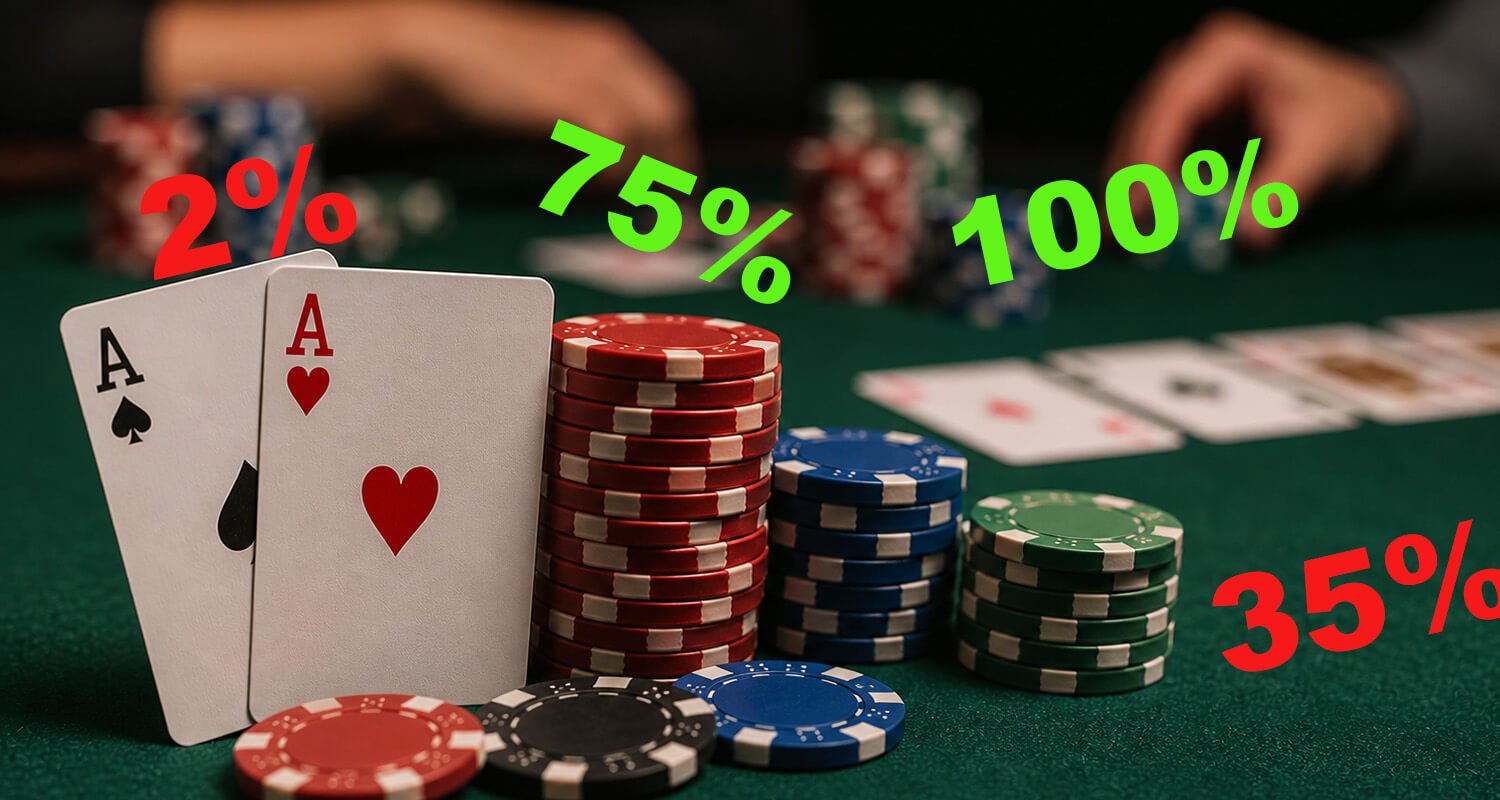
Poker odds are the probability of winning a hand based on the cards you have, the cards on the table, and the number of opponents. Understanding poker odds helps you make better decisions and improve your long-term results.
In this beginner’s guide, you will learn what poker odds are, how they work, and how to use them in real games.

What Are Poker Odds?
Poker odds measure how likely it is that you will win a hand.
They are usually expressed as:
A percentage (e.g. 35% chance to win)
A ratio (e.g. 2 to 1)
👉 In simple terms:
Poker odds tell you how often your hand will win if the same situation happens many times.
Why Are Poker Odds Important?
Poker is not just about luck. Over time, players who make better decisions based on probability will win more often.
Poker odds help you:
- Decide whether to call, fold, or raise
- Understand the strength of your hand
- Compare your chances against opponents
- Avoid costly mistakes
Types of Poker Odds
There are a few key types of odds every beginner should know:
- Hand Odds
This is the chance your hand will win against another hand.
Example:
Pair vs overcards
Flush draw vs made hand
- Pot Odds
Pot odds compare:
The size of the pot
The cost of calling a bet
👉 They help you decide if a call is profitable.
- Implied Odds
Implied odds consider:
How much more money you can win later in the hand
This is important when you are drawing to a strong hand.

Simple Example of Poker Odds
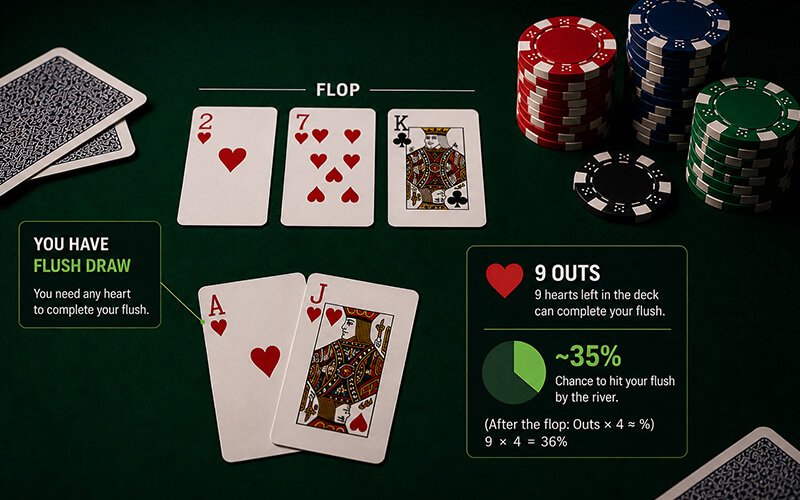
Imagine you have a flush draw on the flop.
There are 9 cards (outs) that complete your flush.
👉 Rough chance:
About 35% to hit by the river
This means:
You will complete your flush roughly 1 out of 3 times
What Are “Outs” in Poker?
Outs are the cards that improve your hand to a likely winning hand.
Example:
You have four cards to a flush → 9 outs
You need one more card for a straight → usually 8 or 4 outs
Knowing your outs is the first step to calculating poker odds.
How to Calculate Poker Odds
You can estimate odds using simple rules:
The Rule of 2 and 4
After the flop → multiply outs by 4
After the turn → multiply outs by 2
Example:
9 outs on flop → 9 × 4 = ~36%
This is a quick way to estimate your chances during a hand.
Poker Odds vs Poker Strategy
Poker odds are only part of the game.
You also need to consider:
- Your position
- Your opponents
- Betting patterns
- Stack sizes
👉 The best players combine odds with strategy.

Common Beginner Mistakes
Many new players misunderstand poker odds:
- Ignoring pot odds when calling bets
- Overvaluing weak draws
- Playing too many hands
- Not considering multiple opponents
Avoiding these mistakes will improve your game quickly.
When Should You Use Poker Odds?
Poker odds are useful in:
- Cash games
- Tournaments
- Online poker
- Live poker
- Study and practice
They are especially important when you are deciding whether to continue in a hand.
Using a Poker Odds Calculator
While you can estimate odds manually, many players use tools.
👉 A Poker Odds Calculator can:
- Calculate exact winning percentages
- Handle multiple players
- Analyze complex situations
- Work for Texas Hold’em and Omaha
You can use our Poker Odds Calculator for FREE here
This makes learning faster and more accurate.
FAQ About Poker Odds
What are poker odds in simple terms?
Poker odds are the chance of winning a hand based on the cards in play.
Are poker odds always exact?
Manual calculations are estimates. Tools can give exact probabilities.
Do poker odds guarantee you will win?
No. They only show probability, not certainty.
Is poker more skill or luck?
Short term → luck
Long term → skill and correct decisions
Final Thoughts
Poker odds are one of the most important concepts in poker. By understanding probability, you can make smarter decisions, avoid mistakes, and improve your long-term results.
You do not need to be a math expert to use poker odds. Start with simple concepts like outs and pot odds, and build from there.
👉 Next step: Try the Poker.kim Poker Odds Calculator to see real-time probabilities and improve your understanding faster.