
Understanding poker odds is one of the fastest ways to improve your results in Texas Hold’em. Whether you are playing online, live tournaments, or home games, knowing how often a hand is likely to win helps you make better decisions.
This guide includes a simple Texas Hold’em odds chart with common preflop and postflop probabilities, along with examples beginners can easily understand.

What Are Texas Hold’em Odds?
Texas Hold’em odds represent the probability of winning a hand based on:
- Your hole cards
- The community cards
- The number of opponents
Poker odds are usually shown as:
- Percentages
- Ratios
- Equity percentages
Why Poker Odds Matter
Poker is a game of long-term decisions. Good players rely on probability instead of guessing.
Understanding odds helps you:
- Know when to call or fold
- Understand drawing hands
- Avoid expensive mistakes
- Make profitable decisions over time
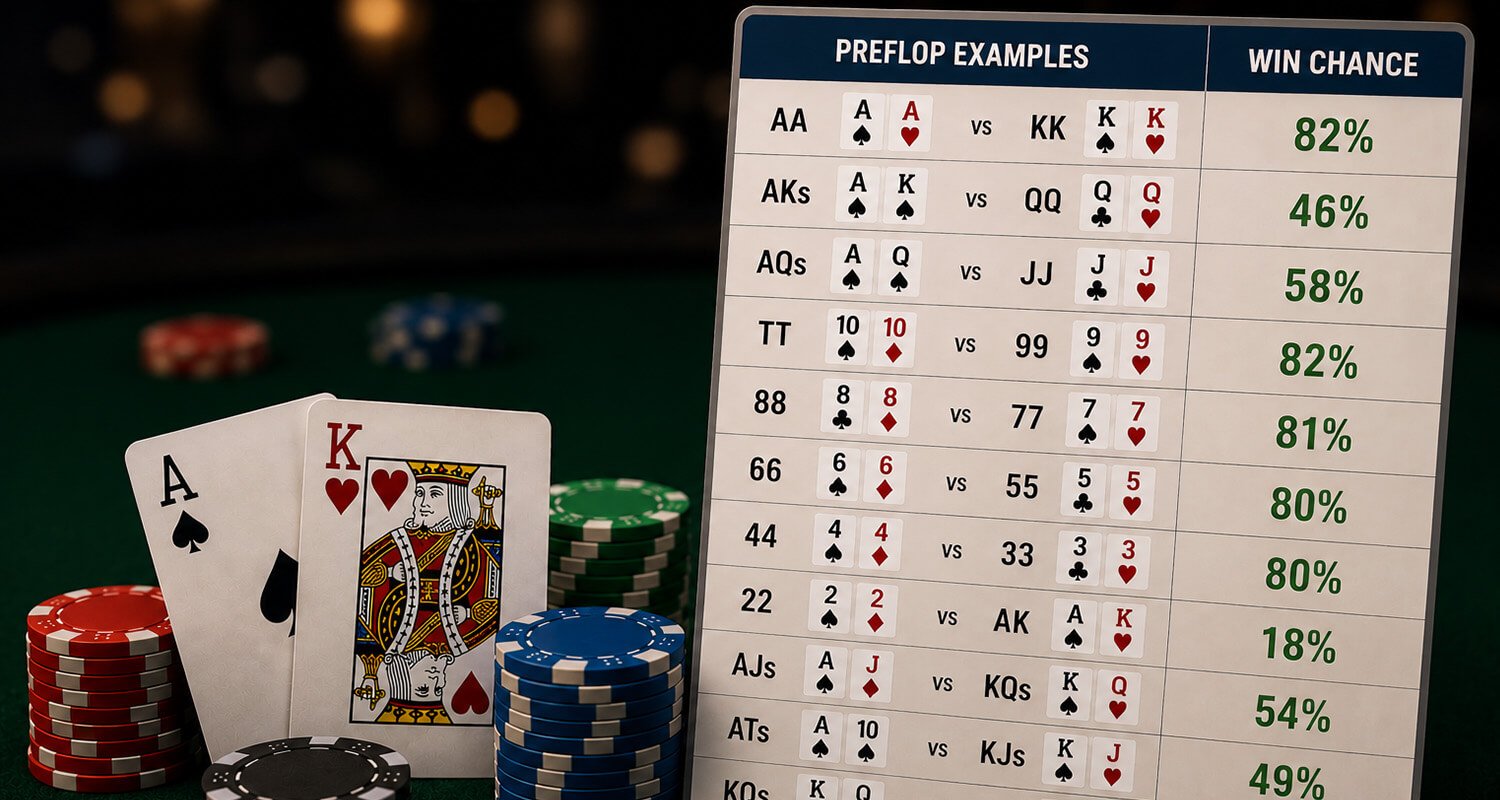
Texas Hold’em Preflop Odds Chart
Here are some common preflop matchups in Texas Hold’em.
Hand Matchup Winning Chance
AA vs KK ~82%
AK suited vs QQ ~46%
AK vs AK ~50%
Small Pair vs Overcards ~53%
Two Overcards vs Two Lower Cards ~46%
Pocket Pair vs Pocket Pair (higher pair) ~80%
See the full pre-flop chart here

Best Starting Hands in Texas Hold’em
Strong starting hands naturally have better odds.
Premium Hands
AA (Pocket Aces)
KK (Pocket Kings)
QQ (Pocket Queens)
AK suited
Medium Strength Hands
JJ
TT
AQ suited
Drawing Hands
Suited connectors
Small pocket pairs
Test our FREE Poker odds calculator HERE
Postflop Odds Chart
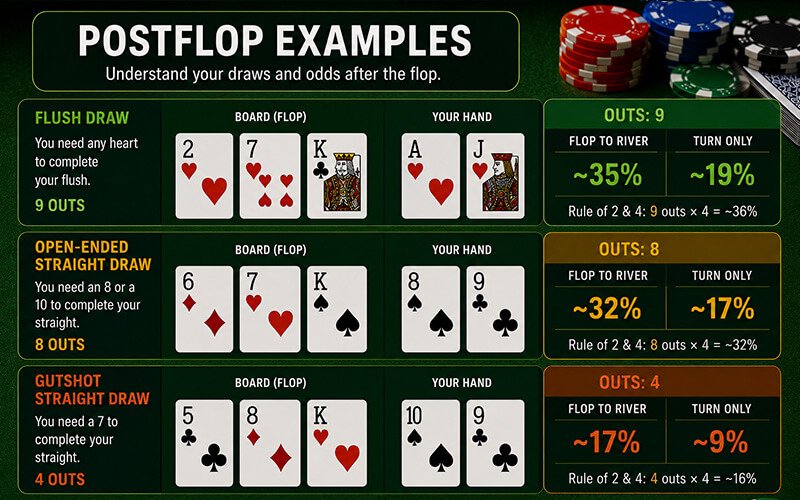
Postflop odds become important when drawing to straights, flushes, or stronger hands.
Flush Draw Odds
Example:
You have:
A♥ J♥
Flop:
2♥ 7♥ K♣
You have a flush draw with 9 outs.
Situation Chance to Improve
Flop → River ~35%
Turn only ~19%
Open-Ended Straight Draw Odds
Example:
8♠ 9♣
Board: 6♦ 7♥ K♠
You have 8 outs.
Situation Chance to Improve
Flop → River ~32%
Turn only ~17%
Gutshot Straight Draw Odds
A gutshot has fewer outs and lower probability.
Situation Chance to Improve
Flop → River ~17%
Turn only ~9%
The Rule of 2 and 4
A simple way to estimate odds in real time:
After the flop:
Multiply outs by 4.
After the turn:
Multiply outs by 2.
Example:
9 outs × 4 ≈ 36%
This gives a quick estimate without complicated math.

Odds Change With More Players
Your winning chances decrease as more players enter the hand.
Example:
AA vs 1 player → very strong
AA vs 5 players → lower overall equity
This is why multiway pots require different strategy.
Texas Hold’em Odds vs Pot Odds
These concepts are connected but different.
Poker Odds
Your chance of winning the hand.
Pot Odds
The price you are getting to continue in the hand.
Good players compare both before making decisions.
Common Beginner Mistakes
Many new players misunderstand poker odds:
- Overvaluing weak draws
- Calling too often
- Ignoring pot odds
- Forgetting multiway equity
Understanding basic probabilities can immediately improve your game.
Use a Poker Odds Calculator
While charts are useful, real poker situations can become complicated quickly.
👉 A Poker Odds Calculator helps you:
- Analyze exact probabilities
- Add multiple players
- Calculate odds preflop, flop, and turn
- Compare different hands instantly
This is especially useful for studying Texas Hold’em and Pot Limit Omaha.
FAQ About Texas Hold’em Odds
What is the best starting hand in Texas Hold’em?
Pocket Aces (AA) is the strongest starting hand.
How often does a flush draw hit?
A flush draw on the flop completes by the river about 35% of the time.
What are outs in poker?
Outs are cards that improve your hand to a likely winner.
Do poker odds guarantee results?
No. Odds represent probability over time, not guaranteed outcomes.

Final Thoughts
Learning Texas Hold’em odds is one of the most important steps toward becoming a better poker player. By understanding probabilities before and after the flop, you can make smarter decisions and avoid costly mistakes.
Use charts to learn the basics, then practice with a Poker Odds Calculator to understand real game situations more accurately.