
If you’re looking to learn a fresh, intriguing poker variant that challenges your skills in a new way, 2-7 Triple Draw might just be what you want. This game stands apart from the more commonly known Texas Hold’em or Omaha, offering a unique lowball style that requires a different strategy and mindset. Understanding the 2-7 triple draw rules is essential before jumping into a game, especially if you’re a beginner. In this guide, we’ll break down the fundamental rules, how the gameplay flows, and some practical tips to get you started confidently.
What is 2-7 Triple Draw Poker?
2-7 Triple Draw is a lowball poker variant. Unlike standard poker games, where the highest hand wins, in 2-7 Triple Draw, the goal is to make the lowest possible five-card hand. The “2-7” refers to the fact that the best hand you can have is 2-3-4-5-7, with no flushes or straights allowed. The “Triple Draw” means players can draw cards up to three times over the course of a hand, giving opportunities to improve their low hand incrementally.
This game is often played using a fixed-limit betting structure, making it easier for beginners to manage their bets and focus more on hand selection and strategy.

Basic Gameplay and Setup
2-7 Triple Draw usually involves 2 to 6 players seated around a poker table. The game is played with a standard 52-card deck and follows the general order of play found in other poker games, but with some important differences:
- The Dealer and Blinds: A dealer button rotates clockwise each hand, marking who deals the cards. Like many poker games, 2-7 Triple Draw uses forced bets called the small blind and big blind to start the pot.
- Dealing the Cards: Each player is dealt 5 cards face down. Players check their cards but keep them hidden from others.
Example:
After the blinds are posted, the dealer deals 5 cards to each player. Player A receives 5 cards: 7♦, 9♣, 3♥, 5♠, and J♠.

Understanding Hand Rankings in 2-7 Triple Draw Rules
The hand rankings in 2-7 Triple Draw are quite different from those in Texas Hold’em or Omaha. Here, the lowest hand wins the pot, and the rank is determined using the following principles:
- Hands are ranked from the highest card downward. The hand with the lowest “high card” wins.
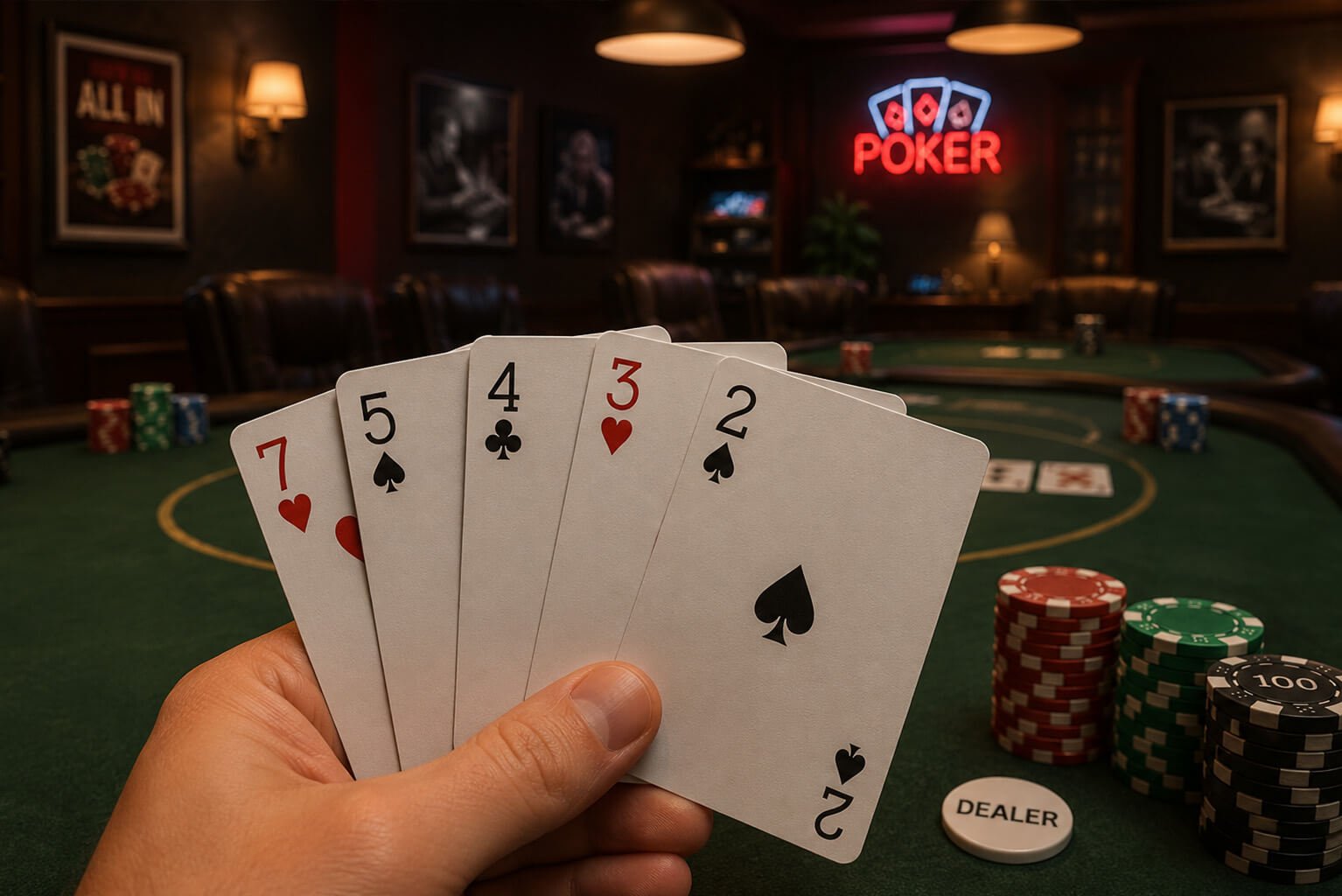
- The best possible hand is 7-5-4-3-2, with no flush or straight allowed. Note that the 7 is the highest card you want.
- Aces are always high in this game, so they count against you.
- Flushes and straights count against you; the lowest hand cannot be a flush or a straight. For example, A-2-3-4-5 is actually a straight and is considered a bad hand in 2-7 Triple Draw.
Example:
- 7♦ 5♠ 4♣ 3♥ 2♦ = Best possible hand
- 8♠ 6♦ 4♠ 3♣ 2♥ = Second best hand
- K♦ 7♣ 6♥ 4♦ 3♠ = Poor hand since King is high
Watch this video to learn from Daniel Negreanu
The Betting Rounds and Drawing Phase
One of the most exciting aspects of 2-7 Triple Draw is that players get three chances to exchange cards. Here’s how the betting and drawing phases typically flow:
- First Betting Round: After the initial 5 cards are dealt, the first round of betting begins with the player to the left of the big blind.
- First Draw: Starting with the player left of the dealer, each player can discard any number of cards (0 to 5) and receive new cards from the dealer. Players aim to improve their hand.
- Second Betting Round: Another round of betting occurs after the draw.
- Second Draw: A second opportunity to discard and receive new cards.
- Third Betting Round: Another betting round after the second draw.
- Third Draw: The final draw for new cards.
- Final Betting Round: The last betting round before the showdown.
- Showdown: Players reveal their hands, and the lowest hand wins the pot.
How the Draw Works
During a draw, the dealer deals replacement cards to each player based on how many cards they discarded. For example, if you discard two cards, you get two new cards. You discard your unwanted cards face down into the dealer’s pile. This process repeats for each player in turn, so be mindful of how many cards others might be drawing — it gives clues about their hand.

Practical Tip:
Drawing no cards can be a strong signal that you already have a very good low hand, so keeping your cards as is can sometimes bluff your opponents or make them unsure.
Betting Structure
Typically, 2-7 Triple Draw is played using fixed-limit betting, which means the betting amounts are set to fixed increments, often represented by the big blind and a higher limit on later betting rounds.
- Pre-draw and first two betting rounds: small bet size (usually equal to the big blind)
- Last two betting rounds: bigger bet size (twice the small bet)
This structure keeps the game balanced and avoids overly large bets that can intimidate newer players. Fixed-limit also makes it easier to understand and practice the game without worrying too much about bet sizing.
Strategy Basics for Beginners
Here are some beginner-friendly tips to keep in mind while playing 2-7 Triple Draw:
- Focus on low cards: Aim to build hands with no cards higher than 8. Remember, 7-5-4-3-2 is the perfect hand, so anything close is good.
- Watch the number of cards your opponents draw: Fewer cards usually mean a stronger hand.
- Be cautious of straights and flushes: Avoid hands that could improve to straights or flushes because these hurt your low hand’s rank.
- Consider drawing only part of your hand: Sometimes you only need to replace one or two cards to improve your hand without sacrificing useful low cards you already hold.
- Manage your bankroll: Limit the number of chips you bring to each game session as it’s easy to get caught up in the multiple betting rounds.

Example Hand Walkthrough
Let’s break down a sample hand to illustrate the 2-7 triple draw rules and gameplay:
Player 1 has: 9♣, 7♦, 5♠, 3♥, 4♣
Player 2 has: J♠, 6♥, 5♣, 4♦, 2♦
First round of betting: Player 1 checks, Player 2 bets, Player 1 calls.
First draw: Player 1 discards the 9♣ and draws a 2♠, improving their hand to 7♦, 5♠, 3♥, 4♣, 2♠.
Player 2 discards the J♠ and draws 7♣ to get 7♣, 6♥, 5♣, 4♦, 2♦.
Second betting round: Player 1 bets, Player 2 calls.
Second draw: Player 1 stands pat (does not draw cards).
Player 2 discards the 7♣ and draws 3♣ to get 6♥, 5♣, 4♦, 3♣, 2♦.
Third betting round: Player 1 bets, Player 2 calls.
Third draw: Player 1 stands pat.
Player 2 stands pat.
Final betting round: Player 1 bets, Player 2 calls.
Showdown: Player 1’s hand: 7♦, 5♠, 4♣, 3♥, 2♠ (ranking: 7-high, very good low hand)
Player 2’s hand: 6♥, 5♣, 4♦, 3♣, 2♦ (ranking: 6-high, better low hand)
Player 2 wins the pot with the lower hand.
Common Mistakes to Avoid
- Misunderstanding hand rankings (e.g., thinking that aces are low or that straights and flushes help your hand).
- Overdrawing: discarding too many cards early and reducing your chance to hold powerful low cards.
- Not paying attention to betting patterns and draw behavior from other players.
- Playing too aggressively or passively without adjusting to the fixed-limit structure.
Why Learn 2-7 Triple Draw?
2-7 Triple Draw offers a refreshing challenge different from the more popular high-hand poker games. Its unique lowball hand rankings sharpen your hand reading skills and patience. It also helps improve your understanding of pot odds and drawing calculations due to the multiple draw rounds and fixed betting structure.
Whether you’re a casual home game player or aspiring to compete in lowball cash games or tournaments, mastering these 2-7 triple draw rules will open the door to new opportunities and enjoyment in the vast world of poker.
Conclusion
Understanding the 2-7 triple draw rules is your first step to exploring this fascinating lowball variant. Remember, the key goals are to aim for the lowest possible five-card hand without straights or flushes, to use your draws wisely, and to pay close attention to your opponents. The structure encourages strategic play and adaptability, making it a rewarding game to learn.
Start practicing, keep these basics in mind, and enjoy the unique thrill that 2-7 Triple Draw poker brings to the table!