
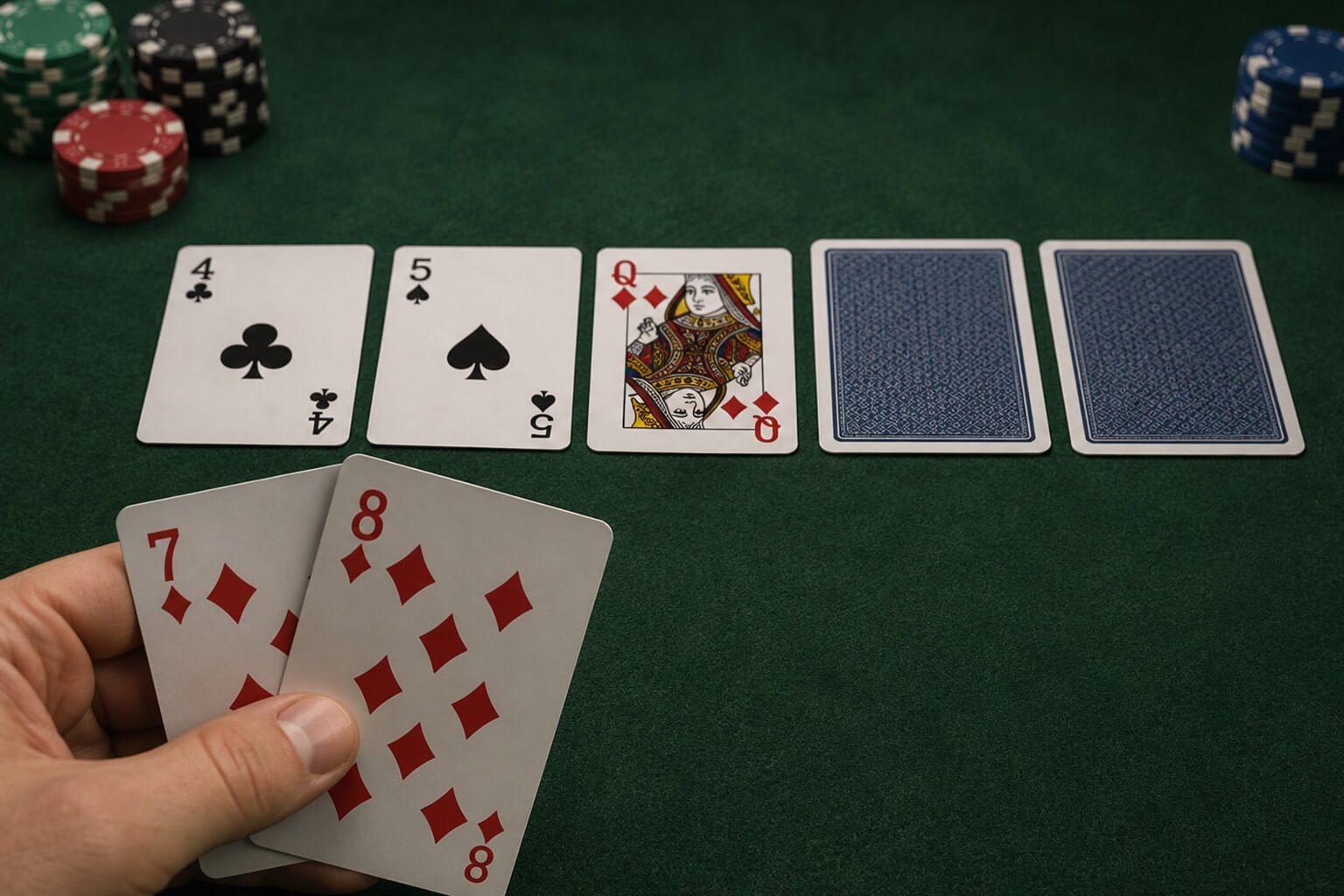
When you’re sitting at the poker table, understanding the different types of draws can significantly improve your game and decision-making. One common term you’ll hear in poker discussions is the gutshot straight draw. If you’re new to poker, it might sound confusing at first, but once you break it down, it’s a simple and important concept to grasp. This article will explain exactly what a gutshot straight draw is, how it works, and how you can use it to your advantage in your gameplay.

What Is a Gutshot Straight Draw?
In poker, a straight is a hand where you have five cards in consecutive order, but not all of the same suit. A gutshot straight draw (also known as an inside straight draw) is when you’re missing one card inside the sequence to complete your straight.
Think of it like this: if you have cards that form four out of five consecutive ranks but the missing card is somewhere in the middle, not on the ends, that’s a gutshot straight draw. For example, if you hold 5♠ and 6♦, and the flop comes 4♣, 7♥, K♦, you have four cards towards a straight – 4, 5, 6, and 7 – but you are missing the 3 or 8 to complete a straight. Since the 3 is not on the board, and the 8 isn’t either, this hand isn’t a gutshot draw but an open-ended straight draw. But if the flop came 4♣, 8♥, Q♦ instead, then you’re actually missing the 7; this setup wouldn’t quite fit a gutshot straight draw. Let’s look at a clearer example:
- You hold:4♠ and 5♦
- Flop: 7♣, 8♥, K♦
Here, you’re looking to complete a straight of 4-5-6-7-8. You have four of the five cards (4, 5, 7, 8), but you’re missing the 6. So this is a gutshot.
A Cleaner Gutshot Straight Draw Example
Suppose you’re holding 4♠ and 8♦, and the flop reveals 6♣, 7♠, and Q♣. Your cards and the community cards show 4, 6, 7, 8, but you’re missing the 5 to complete the straight. Since the missing card (5) is in the middle of the straight sequence, this is a clear gutshot straight draw.
In summary:
- An open-ended straight draw means you can complete your straight by hitting one of two cards on either end of your sequence.
- A gutshot straight draw means you need exactly one specific card in the middle of the sequence to complete your straight.
How to Identify a Gutshot Straight Draw
Identifying a gutshot straight draw involves spotting whether your hand setup is missing one card inside a potential straight line. It’s about recognizing the gap location within the five cards needed to complete your straight.
Here’s a simple method to check:
- List the ranks of your hole cards together with the community cards.
- Look for four cards that can be part of a five-card straight but with one card missing inside the sequence.
- Check if the missing card is only one rank away, and specifically inside the sequence, not on an end.
If the missing card fits this description, you have a gutshot straight draw.
Gutshot Straight Draw vs. Open-Ended Straight Draw
It’s helpful to distinguish between these two types of straight draws because they have different odds and strategic implications:
| Criteria | Gutshot Straight Draw | Open-Ended Straight Draw |
|---|---|---|
| Cards Needed | 1 specific card (inside the sequence) | 2 possible cards (either end of the sequence) |
| Number of Outs | Usually 4 outs | Usually 8 outs |
| Odds on the Turn or River | Lower chance to complete the straight | Higher chance to complete the straight |
“Outs” refers to the number of cards remaining in the deck that can give you the winning hand. Since a gutshot straight draw requires one specific card, you generally have fewer outs, making it a riskier draw compared to an open-ended straight draw. Read more about outs here

The Odds Behind a Gutshot Straight Draw
Knowing the odds can help you decide whether chasing a gutshot straight draw makes sense in a hand. To calculate the odds, consider that there are typically four cards of each rank remaining in the deck (unless some have already been folded or revealed). Since you need a very specific card, you generally have 4 outs to complete your straight.
To put it simply:
- If you’re on the flop (seeing two more cards – turn and river), the chance of hitting your gutshot straight draw by the river is about 16.5%.
- If you’re on the turn (only one more card to come), your chance of completing the gutshot is about 8.5%.
The lower chances make chasing a gutshot straight draw a riskier play, especially if you need to call a big bet. You can practice calculating odds with our free Poker Odds Calculator HERE
How to Play a Gutshot Straight Draw Effectively
Whether to play a gutshot straight draw depends on several factors including pot odds, position, stack size, and opponents’ tendencies.
Consider the Pot Odds
Pot odds tell you how much you stand to win compared to what you must call to continue in the hand. If the pot odds are favorable—for example, the pot is large enough compared to your call—the questionably low odds of a gutshot straight draw can be profitable to chase.
Learn more about Pot Odds here.
Position Matters
If you have a gutshot draw and are acting last (on the button or in late position), you can control the betting better. It’s easier to call a moderate bet or even raise as a semi-bluff with good post-flop play. Being in an early position means you have less information and might want to play more cautiously.
Stack Size
Your effective stack size plays a huge role. If you have plenty of chips behind, calling or raising with a gutshot draw might be worthwhile, especially in deep stack games. When stacks are shallow, the risk often outweighs the reward. This is because your hand is more hidden, so you can more easily get paid well if you hit your gutshot.
Reading Your Opponents
If you believe your opponents are strong and willing to bet big, it may be better to fold the gutshot draw, unless pot odds favor you heavily. On the other hand, if the table is passive, you can often see the turn or river for cheap.

Using the Draw as a Bluff
Sometimes, having a gutshot straight draw opens up creative bluffing opportunities. Players with a gutshot draw can semi-bluff by raising or betting to put pressure on opponents, even if you don’t complete the straight, giving you multiple ways to win the pot.
Practical Example: Playing a Gutshot Straight Draw
Imagine you are playing no-limit Texas Hold’em, and you have 5♦ 9♦ in your hand. The flop comes 7♣ 8♠ K♥. This means you have a gutshot straight draw needing the 6 to complete 5-6-7-8-9.
The pot is $100 and your opponent bets $30. What should you do?
- Calculate your outs: There are 4 cards (four 6s in the deck) to complete your straight.
- Check your pot odds: You need to call $30 to win $130 (the pot plus opponent’s bet), giving you pot odds of roughly 4.3 to 1.
- Compare to odds of hitting your draw: As we mentioned, hitting your gutshot by the river is about 4 to 1 against (16.5% chance).
Since the pot odds are just slightly better than your odds of hitting the straight, a call is reasonable here. But if your opponent bets $70 or more, the pot odds become worse, making a call less attractive. But if both you and your opponent have deep stacks, it may still be worth sticking around if you think he will still call you if you hit a six on the turn. This is called implied odds.
Summary
A gutshot straight draw is a common but often tricky situation in poker. It happens when you need one very specific card inside your sequence to complete a straight. Understanding what a gutshot straight draw is, its odds, and how to play it is essential for making smart decisions at the poker table.
Remember these key points:
- Gutshot straight draws require one specific card to complete the straight.
- You usually have 4 outs, resulting in a roughly 16.5% chance to complete by the river.
- Consider pot odds, position, and stack sizes before chasing the draw.
- Gutshot draws can be used as semi-bluffs, adding a strategic layer to your game.
Mastering gutshot straight draws will help you better evaluate your hands, improve your betting strategies, and ultimately win more pots. So next time you see a draw with a missing middle card, remember what you learned here and use it to your advantage!
Editorial Note
Poker.kim uses artificial intelligence to assist with some content, including illustrations and draft text. Every article is reviewed, edited, and approved by our editorial team before publication.
If you spot an error or outdated information, we’d appreciate hearing from you so we can improve our content.