
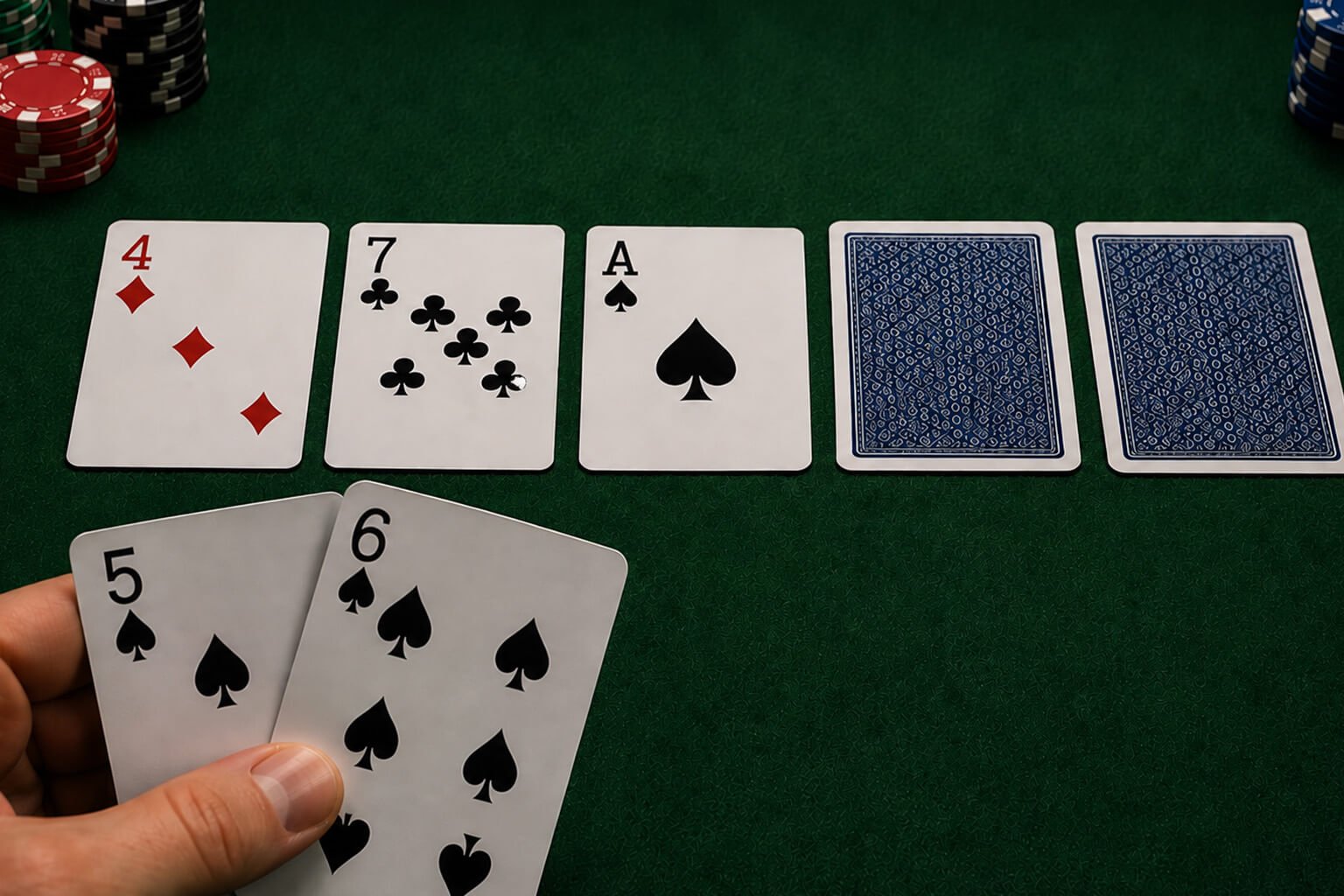
If you’re new to poker or trying to sharpen your understanding of the game, you’ve likely heard about a variety of drawing hands and their importance. One of the most exciting and effective drawing hands is the open-ended straight draw. This concept is a fundamental part of poker strategy that can significantly influence your decision-making at the table.
What is an Open-Ended Straight Draw?
Simply put, an open-ended straight draw is a hand where you have four consecutive cards that could complete a straight by hitting one of two possible cards. This means there are eight cards left in the deck that can give you a straight, four on each end of your current sequence.

For example, imagine you hold 6♠ 7♣ and the flop comes 8♦ 9♠ 2♣. Here, you have 6-7-8-9 in sequence. To complete a straight, you need either a 5 or a 10. Both 5s and 10s complete your straight, which is why it’s called an open-ended straight draw – the straight can be completed on either end.
How Does an Open-Ended Straight Draw Work?
To understand how strong an open-ended straight draw is, it’s helpful to think about the number of “outs” you have. In poker, outs are the cards that can improve your hand to what you believe will be the winning combination.
For an open-ended straight draw, you have eight outs:
- The four cards that can fill the gap on the lower end (in our example, the 5s)
- The four cards that can fill the gap on the higher end (the 10s)
With eight outs, the chances of hitting your straight by the river are quite favorable, making it one of the more appealing drawing hands in poker.
Open-Ended Straight Draw vs. Inside Straight Draw
It’s important to understand how an open-ended straight draw differs from an inside straight draw (also known as a gutshot straight draw). An inside straight draw requires hitting only one specific card rank to complete your straight.
For example, if you have 9♠ 7♣ and the board is 4♦ 8♠ J♣, you’re hoping to hit a 10 for a straight. You only have four outs (the 10s) compared to the eight outs on an open-ended straight draw. This gives the open-ended straight draw approximately double the chances of completing a straight compared to an inside draw.
Why is an Open-Ended Straight Draw Valuable?
One of the huge advantages of an open-ended straight draw is the number of outs. That means you often have better pot odds and implied odds when chasing your hand. Pot odds refer to the ratio of the current pot size to the cost of a contemplated call, and implied odds consider future bets you might win if you hit your draw.
Because the open-ended straight draw is quite versatile and hits enough outs, you can make informed decisions about when to call, raise, or fold, depending on the pot size, stack depths, and opponent tendencies.
Understanding the Odds
Knowing the approximate odds of completing your straight draw is key to making the right decisions. Since there are 52 cards in the deck and you know your two hole cards plus the community cards, you can estimate the number of unknown cards left.
Generally speaking:
- If you have an open-ended straight draw on the flop, you have about a 31.5% chance to hit your straight by the river.
- If you’re on the turn with an open-ended straight draw, your chance to complete the straight on the river is roughly 17%.
These percentages are strong enough to justify drawing in many scenarios, especially if the pot odds are favorable.
How to Play an Open-Ended Straight Draw
Playing with an open-ended straight draw often depends on your position, how much you can win from the pot, and your read on opponents. Here are some common strategies:
1. Semi-Bluffing
If you have an open-ended straight draw and a hand that can still win if your opponent folds, you might consider a semi-bluff. This means you raise or bet aggressively, putting pressure on your opponent while having the backup plan of hitting your straight if called.
2. Drawing with Pot Odds
If the pot odds justify a call — meaning the potential reward is greater than the risk — then calling with an open-ended straight draw is usually a good decision. For example, if the pot contains $100 and your opponent bets $20, you’re getting 5-to-1 odds, which often beats the roughly 3-to-1 odds of hitting your straight.
3. Slow Playing
Sometimes, if you believe your opponent has a strong hand but you can still win if you hit your straight, you might just call or check and try to hit your draw cheaply rather than building the pot early.

Practical Examples
Here’s an example to bring the concept to life:
You’re holding 8♠ 9♠, and the flop is 6♦ 7♦ K♣. You now have 6-7-8-9, which means a 5 or 10 will make your straight. This is an open-ended straight draw with eight outs. If the pot size is $50 and it costs you $10 to call your opponent’s bet, your pot odds ($50 : $10) are 5-to-1. Since your odds to hit the straight are about 3-to-1, it’s a profitable call.
Alternatively, if you raise here, you put your opponent in a tough spot. They might fold better hands, or call and give you a chance to hit your straight on the turn or river. This is a hybrid approach where you leverage the strength and potential of your draw.
Tips When Playing Open-Ended Straight Draws
- Pay attention to the board texture: If the board is “wet” with lots of possible straights and flushes, be cautious because your opponent could already have a better hand or a stronger draw.
- Consider blockers: Holding cards that reduce your opponent’s potential outs can improve the value of your draw.
- Evaluate implied odds: If your opponent is likely to pay you off with a big pot when you hit your straight, drawing becomes more profitable.
- Beware of reverse implied odds: Sometimes hitting your straight may still lose to a higher straight or a flush. In those cases, proceed with caution.
Conclusion
The open-ended straight draw is a powerful concept that every poker player should understand. It provides multiple opportunities to improve your hand, gives you good drawing odds, and can be used both aggressively and passively depending on the situation. By recognizing these draws and knowing how to play them correctly, you can increase your win rate and make your poker game more dynamic and fun.
Next time you see four consecutive cards that can be completed on either side, remember—you might just have an open-ended straight draw, and with it, a great chance to turn a good hand into a winning one.

Editorial Note
Poker.kim uses artificial intelligence to assist with some content, including illustrations and draft text. Every article is reviewed, edited, and approved by our editorial team before publication.
If you spot an error or outdated information, we’d appreciate hearing from you so we can improve our content.