
Poker is a game filled with a variety of hands and strategies, and understanding the strength and ranking of these hands is essential for anyone looking to improve their game. Among the many possible hands, a straight flush is one of the most powerful and exciting to hold. If you’re new to poker or simply want to deepen your knowledge, this article will walk you through what exactly a straight flush is, why it’s so valuable, and how it fits into the bigger picture of poker hands.
What Is a Straight Flush in Poker?
In poker, a straight flush is a hand that consists of five cards in numerical order, all of the same suit. To put it simply, imagine having five consecutive cards — like 5-6-7-8-9 — and all of them belong to hearts, diamonds, clubs, or spades. This combination makes a straight flush.
For example, a hand with 7♥, 8♥, 9♥, 10♥, J♥ is a straight flush because these cards are all hearts and form a sequence in numerical order. It’s important that these cards are both consecutive and of the same suit — if just one of those conditions isn’t met, it’s not a straight flush.

How Does a Straight Flush Compare to Other Hands?
In the hierarchy of poker hands, understanding where a straight flush ranks can greatly influence your betting, raising, and calling decisions. Here’s a quick look at where the straight flush stands among common poker hands (from highest to lowest):
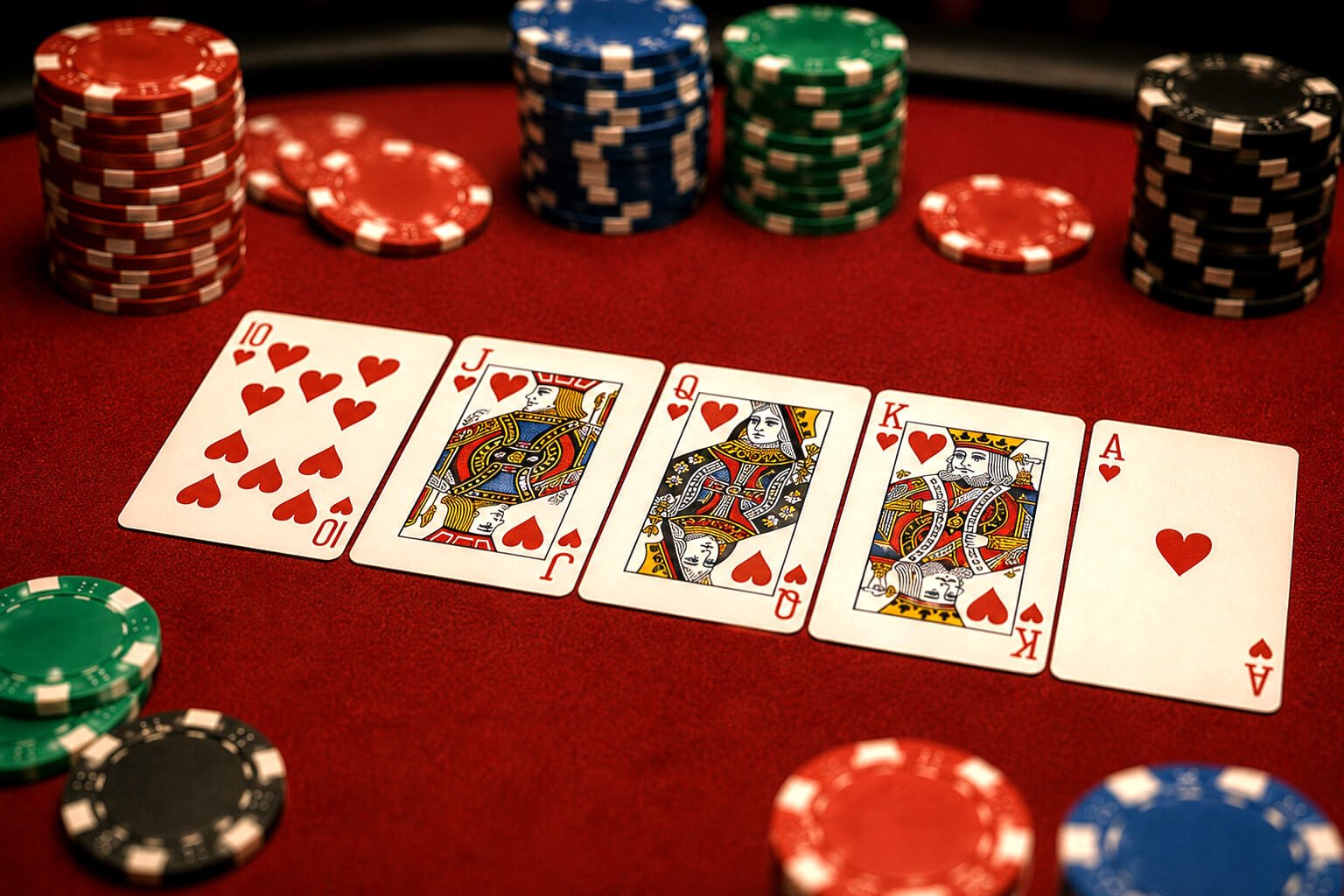
- Royal Flush: The absolute best hand, which is a straight flush running from 10 to Ace (10-J-Q-K-A of the same suit).
- Straight Flush: Any five consecutive cards of the same suit that aren’t a royal flush (e.g., 5-6-7-8-9 of clubs).
- Four of a Kind: Four cards of the same rank (e.g., four Jacks).
- Full House: Three of a kind plus a pair.
- Flush: Five cards of the same suit, but not in numerical order.
- Straight: Five cards in a sequence but different suits.
- Three of a Kind: Three cards of the same rank.
- Two Pair and lower hands follow.
This ranking means that a straight flush poker hand beats almost everything else on the table except the royal flush, making it extremely powerful.
Red also: What Beats What In Poker?
What Is a Royal Flush?
Since a royal flush is the highest form of straight flush, it’s worth a quick mention. The royal flush consists of the cards 10, Jack, Queen, King, and Ace — all in the same suit.
For example, 10♠, J♠, Q♠, K♠, A♠ is a royal flush, and it is unbeatable in poker play. While the straight flush covers all other five-card runs within one suit, the royal flush specifically is the pinnacle of those sequences.
Read more about Royal Flush HERE.
How Often Does a Straight Flush Occur?
Straight flushes are rare in poker, which adds to their excitement and value. To understand why, consider there are a total of 2,598,960 possible five-card hand combinations in poker.
Out of these:
- There are only 36 possible straight flush hands (including the 4 royal flushes).
- The frequency is roughly 0.0015%, which means you’re unlikely to see a straight flush in everyday poker.
Because of their rarity, hitting a straight flush in a poker game usually leads to winning a large pot, unless you are facing the even rarer royal flush.

Examples of Straight Flush Poker Hands
Let’s go through a few practical examples. Imagine you’re playing Texas Hold’em and you hold the following cards on the board and in your hand:
- Example 1: Your hand: 6♣ 7♣
The board: 8♣ 9♣ 5♣ K♦ 2♥
This gives you 5♣ 6♣ 7♣ 8♣ 9♣ — a straight flush. - Example 2: Your hand: 10♦ J♦
The board: 8♦ 9♦ Q♦ 3♠ 5♥
Here, you have 8♦ 9♦ 10♦ J♦ Q♦ — another straight flush.
Both examples show how using your hole cards with the community cards can form a straight flush. Recognizing these opportunities during a hand can help you make excellent decisions for betting or raising.
How to Play a Straight Flush Hand
When you have a straight flush, you’ll want to maximize your profit. Here are a few tips:
- Slow Play Sometimes: Because opponents may not suspect you have such a strong hand, you might choose to bet small to keep them in the game.
- Raise or Re-Raise: In other scenarios where you feel confident your hand is best, raising to build the pot is a great strategy.
- Watch the Board: If the board is showing cards that enable a straight flush, be cautious, as opponents may also hold one.
Prudent play is important because while a straight flush is very strong, it can still be beaten by a higher straight flush or a royal flush in rare cases.
Common Misconceptions About Straight Flush Hands
It’s easy to confuse different poker hands, especially when you’re just starting out. Here’s a quick rundown of what a straight flush is NOT:
- Not Just a Flush: A flush means five cards of the same suit but do not have to be in sequence. A straight flush needs to be both.
- Not Just a Straight: A straight is five sequential cards, but if they are mixed suits, it’s not a straight flush.
- Higher Is Better: Within the category of straight flushes, the hand with the highest ranking top card wins. So, 9-10-J-Q-K of hearts beats 5-6-7-8-9 of diamonds.
The Role of Straight Flushes in Different Poker Variants
Straight flush hands appear across many poker variations, including Texas Hold’em, Omaha, and Seven-Card Stud. However, how they’re formed and their frequency can differ depending on the variant and the number of cards dealt.
In Texas Hold’em, players use a combination of their two hole cards with five community cards to make the best five-card hand, making straight flushes very rare but still possible. In Omaha, with four hole cards and five community cards, players have more opportunities to form powerful hands like straight flushes, but the higher competition demands careful strategy.
Summary: Why Understanding Straight Flush Poker Hands Matters
In poker, knowledge is power. Knowing what a straight flush is, how rare it’s, where it stands in hand rankings, and how to play it will help you make smarter, more strategic decisions at the table.
The straight flush poker hand is a thrilling combination that almost guarantees a winning round. Recognizing this hand, as well as understanding the difference between a straight flush, flush, and straight, is vital for beginners aiming to up their poker game.
With practice, you’ll begin to spot potential straight flushes early in the hand and learn how to maximize their value, turning an already exciting game into a highly rewarding experience.