
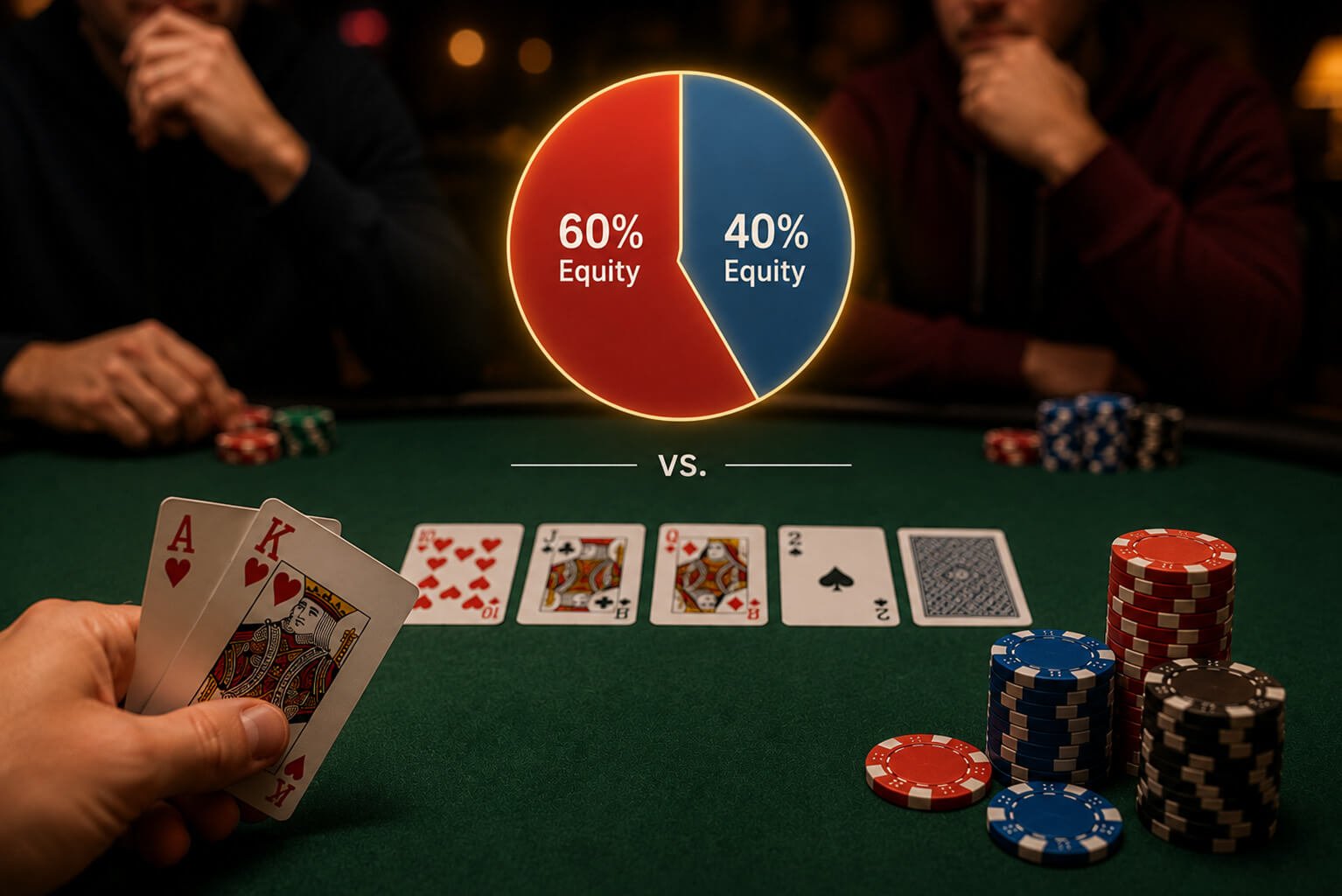
If you’re new to poker or looking to sharpen your skills, understanding the concept of poker equity is essential. Poker equity is a fundamental idea that can help you make smarter decisions at the table by giving you a clearer picture of your chances to win a hand. In this article, we’ll break down poker equity in a beginner-friendly way, explain why it matters, and walk you through practical examples to help you use it effectively in your games.
What Is Poker Equity?
Simply put, poker equity refers to your share of the pot based on your probability of winning the hand at any given moment. It’s expressed as a percentage and tells you how much of the pot you expect to win on average if the hand were played out many times.
For example, if you have 50% equity in a $100 pot, it means you can expect to win $50 on average from that pot. It’s important to remember that poker is a game of probabilities and chance, so equity is about the long-term expectation, not guaranteed wins in every single hand.

Why Understanding Poker Equity Matters
Knowing your poker equity helps you make better decisions in the middle of a hand. Poker isn’t just about the cards you hold — it’s about how those cards stack up against your opponent’s possible holdings and actions.
- Making profitable bets: You want to bet or call when your equity justifies it. If your expected gain (+EV) is positive, you’re making a smart move.
- Knowing when to fold: If your equity is low compared to the cost it takes to stay in the hand, folding is often the better option.
- Reading opponents: By estimating your equity against what you think your opponent has, you can better judge their hand strength and plays.
How Is Poker Equity Calculated?
Calculating exact poker equity can be tricky during fast-paced games, but fundamentally it’s the chance of winning multiplied by the pot size. To find your chance of winning, you need to consider:
- Your hand
- The community cards (flop, turn, and river)
- Your opponent’s possible range of hands
There are tools and software, like equity calculators (PokerStove, Equilab), that run millions of simulations to give you precise equity numbers. However, you can get close by using simple math and poker knowledge.
We have a FREE Poker Odds Calculator, you can find it HERE
Practical Example One: Preflop Equity
Imagine you’re playing Texas Hold’em and have AsKc. Your opponent has a random hand. What’s your poker equity preflop?
Against a single random hand, pocket A-K offsuit has about 65% equity. This means if you played this hand against a random opponent lots of times, you’d expect to win 65% of the pot on average.
This high equity means A-K is a strong preflop hand to play aggressively.

Practical Example Two: Postflop Equity — Counting Outs
Let’s say you have 7♠8♠ and the flop comes 6♥9♠K♦. You have an open-ended straight draw (you need either a 5 or a 10 to complete your straight).
How do you estimate your equity?
You start by counting your “outs” — the cards that improve your hand to a likely winner. You have 8 outs (four 5s and four 10s).
With one card to come (the turn), your chance to hit one of your 8 outs is roughly:
8 outs / 47 unknown cards ≈ 17%
If you consider both the turn and river cards, the probability improves, roughly doubling. This means your equity increases, and you have about a 31-32% chance to complete your straight by the river.
This knowledge helps you decide whether to call a bet, especially depending on the pot size and bet size.
Using Poker Equity in Decision Making
Knowing your equity is not enough if you don’t compare it against the price you pay to continue. This is where the concept of pot odds comes in.
What Are Pot Odds?
Pot odds are the ratio of the current size of the pot to the cost of a contemplated call. For example:
- Pot size: $100
- Opponent bets $20
- Pot is now $120, and you need to call $20
Your pot odds = $20 (cost) / $120 (pot + bet) = 1:6, or about 16.7%.
If your poker equity (chance to win) is higher than your pot odds, calling is statistically correct.
Using the previous straight draw example, if you have about 17% chance to hit on the next card, and the pot is offering you pot odds of 16.7%, calling is justified because your equity is slightly better than the price you’re paying.
Equity Versus Implied Odds
Sometimes pot odds alone don’t tell the whole story. You might be getting the right pot odds to call, but even if you win the hand, the pot could grow bigger on later streets. This is where implied odds come in — the money you expect to win after the current street.
Say you have a draw and the pot odds don’t quite justify a call yet, but if you hit your draw, you expect your opponent to continue betting or calling more money. Those future bets add to your implied odds.
Considering implied odds alongside poker equity gives you a more complete picture and helps balance between immediate odds and potential future profits.
How to Practice Calculating Poker Equity
Practice makes perfect when it comes to estimating poker equity. Here are some tips:
- Use equity calculators off the table: Tools like Poker.kim Poker Odds Calculator help you see how different hands perform against others.
- Train with hand range estimation: Try guessing your opponents’ possible hands and calculate your equity against that range rather than a single hand.
- Review past hands: Revisit your hands after a session or use hand analysis software to understand your equity in those spots.
- Practice counting outs: Get quick at identifying your outs and converting them to approximate equity percentages.
Common Misconceptions About Poker Equity
It’s important to address a few common misconceptions about poker equity:
- Equity guarantees a win: Equity is about expectation over time, not every hand. You can have high equity and still lose a hand.
- Exact equity must be known to play well: While helpful, you don’t need perfect numbers at the table. Estimations are enough for strong decisions.
- Poker equity alone determines whether to call or fold: Other factors like position, table dynamics, and reads also influence decisions.

Final Thoughts
Understanding poker equity is a vital step for anyone looking to improve their poker strategy. It’s the foundation for making smart bets, calls, and folds by connecting your chances of winning with the pot-size and betting costs.
By practicing equity estimation, learning to count outs, and combining equity with pot and implied odds, you’ll be able to make confident moves that increase your long-term winnings. Remember, poker is a game of skill and patience, and mastering equity gives you a real edge over less informed players.
Next time you sit down at the table, focus not only on the cards you hold but also on how those cards compete in your current situation. Even a rough estimate of poker equity will help you play smarter and turn the odds in your favor.
Editorial Note
Poker.kim uses artificial intelligence to assist with some content, including illustrations and draft text. Every article is reviewed, edited, and approved by our editorial team before publication.
If you spot an error or outdated information, we’d appreciate hearing from you so we can improve our content.