
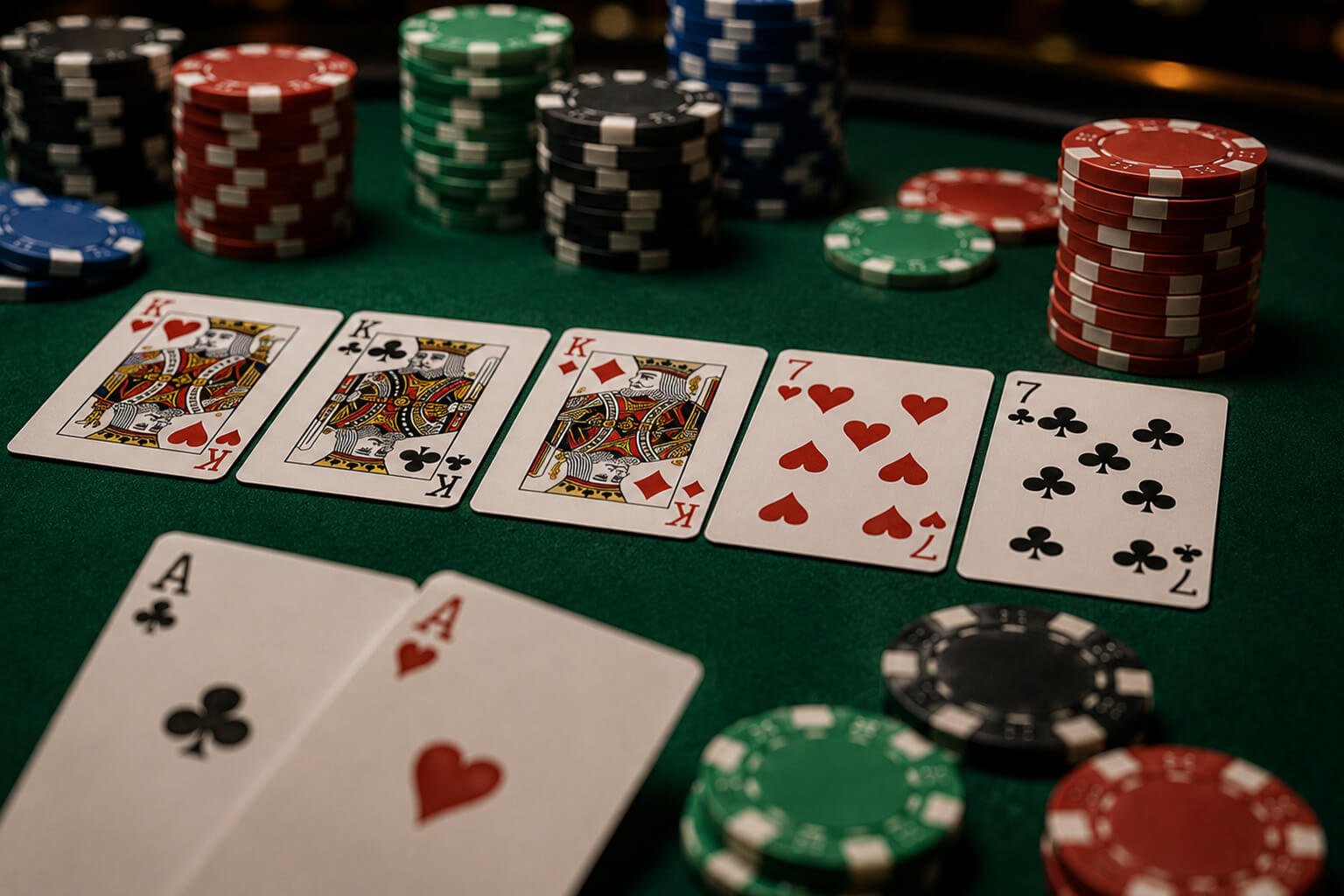
Poker is a game full of exciting hands and strategic decisions. Among the many hand rankings, the full house poker stands out as one of the most powerful and well-recognized hands. Whether you’re a newcomer learning the ropes or looking to brush up on your knowledge, understanding what a full house is and how it fits within the broader world of poker is essential. Let’s dive into the details, explain it with clear examples, and see why this hand can be a game-changer.
What Is a Full House in Poker?
A full house is a poker hand consisting of three cards of one rank and two cards of another rank. In simple terms, it’s a combination of a three-of-a-kind and a pair. For example, if you have three Kings and two 8s, you have a full house, often spoken aloud as “Kings full of eights.”
In classic poker hand rankings, a full house beats many common hands like flushes and straights but loses only to four-of-a-kind, straight flushes, and royal flushes. This solid ranking makes it a highly desirable and powerful hand during any poker game.

How Does a Full House Rank in Poker?
The ranking of poker hands, from strongest to weakest, typically goes: royal flush, straight flush, four-of-a-kind, full house, flush, straight, three-of-a-kind, two pair, one pair, and high card. In this hierarchy, the full house sits quite high, making it a strong contender at the poker table.
Among multiple full houses, the winner is decided first by the rank of the three matching cards. For example, a full house with three Queens beats a full house with three Jacks, regardless of the pair. If two players have the same three-of-a-kind, the pair decides the winner. So, a hand with three Queens and two 10s will beat three Queens and two 9s.
Examples of Full House Hands
Let’s look at some full house examples to make things more concrete:
- Example 1: 5♦ 5♠ 5♣ K♠ K♥ — This is a full house: Three 5s and two Kings, or “Fives full of Kings.”
- Example 2: Q♠ Q♥ Q♦ 7♣ 7♠ — Three Queens and two 7s, called “Queens full of sevens.”
- Example 3: 9♣ 9♦ 9♥ 4♣ 4♦ — Three 9s and two 4s, “Nines full of fours.”
In each case, the hand contains three cards of the same rank and a separate pair. That’s the defining feature of a full house.

How to Make a Full House in Different Poker Games
Full houses can be made in nearly every poker variant, like Texas Hold’em, Omaha, Seven-Card Stud, and more. How you get there may depend on the specific rules and the number of cards dealt.
Texas Hold’em
In Texas Hold’em, you get two private cards and share five community cards with other players. Your full house is made by combining your hole cards with the community cards in any way to form the strongest five-card hand.
Suppose you have A♠ A♦ in your hand, and the board is A♣ K♠ K♥ 7♦ 2♠. Your best hand is three Aces and two Kings, or “Aces full of Kings.” This is a classic full house scenario in Hold’em.
Omaha
Omaha is similar to Texas Hold’em but each player receives four hole cards. Players must use exactly two of their hole cards combined with exactly three community cards to form their five-card hand.
Because of the extra hole cards, full houses are somewhat more common in Omaha, and you should be cautious when betting with seemingly strong hands that might be beaten by a higher full house.
Seven-Card Stud
In Seven-Card Stud, there are no community cards. Each player is dealt seven cards individually (some face-up, some face-down), and the best five-card hand wins.
A full house can arise from any combination of these seven cards. For example, if you have 10♠ 10♦ 10♥ 3♣ 3♦ in your seven cards, your five-card best hand will be a full house: “Tens full of threes.”
Why Is a Full House Important?
Understanding full house poker hands is crucial for several reasons:
- Strong hand potential: It’s a reliable winning hand in various poker formats, especially when the board has pairs or trips.
- Strategic advantages: Knowing when you have a full house or when an opponent might have one can guide your betting decisions.
- Hand reading: Recognizing the strength of a full house allows you to avoid costly mistakes, like folding a winning hand or overvaluing a weaker one.

Tips for Playing a Full House
Having a full house is usually great news, but how you play it depends on the situation:
- Slow play when appropriate: Sometimes, you want to keep weaker hands in by not betting aggressively right away. This is called “slow playing.”
- Stay cautious on scary boards: Even though a full house is strong, if the board shows a possible four-of-a-kind or straight flush, be wary.
- Watch opponents’ betting patterns: If an opponent suddenly raises aggressively on a paired board, they might have an even higher full house or four-of-a-kind.
Common Misconceptions About Full House Poker
Here are some points beginners often get wrong:
- It always wins: While a full house is powerful, it’s not unbeatable. Four-of-a-kind, straight flushes, and royal flushes can beat it.
- Any pair and three-of-a-kind make a full house: True, but you must use exactly five cards. Sometimes, you may have more cards matching, but only the strongest five-card hand counts.
- Full houses are rare: They’re less common than pairs and straights but more common than four-of-a-kind or straight flushes.
How to Identify a Full House Quickly
When playing, it’s helpful to be able to spot a full house fast. Here’s a simple approach:
- Look for three cards of the same rank (“trips” or “three-of-a-kind”).
- Check if there is a pair among the remaining cards.
- If both exist within five cards, it’s a full house.
- Always remember that the primary ranking is the three-of-a-kind, and the pair only breaks ties.
Conclusion
The full house is a classic, strong poker hand that combines the security of three-of-a-kind with the added strength of a pair. It offers plenty of opportunities to win pots and can be the foundation of many exciting poker moments. Whether you’re playing Texas Hold’em, Omaha, or Stud, understanding how to recognize, create, and effectively play a full house will make you a sharper and more confident player.
Keep practicing, pay attention to the cards on the board, and you’ll soon spot full houses with ease—and know just how to get the most out of them at the table.