
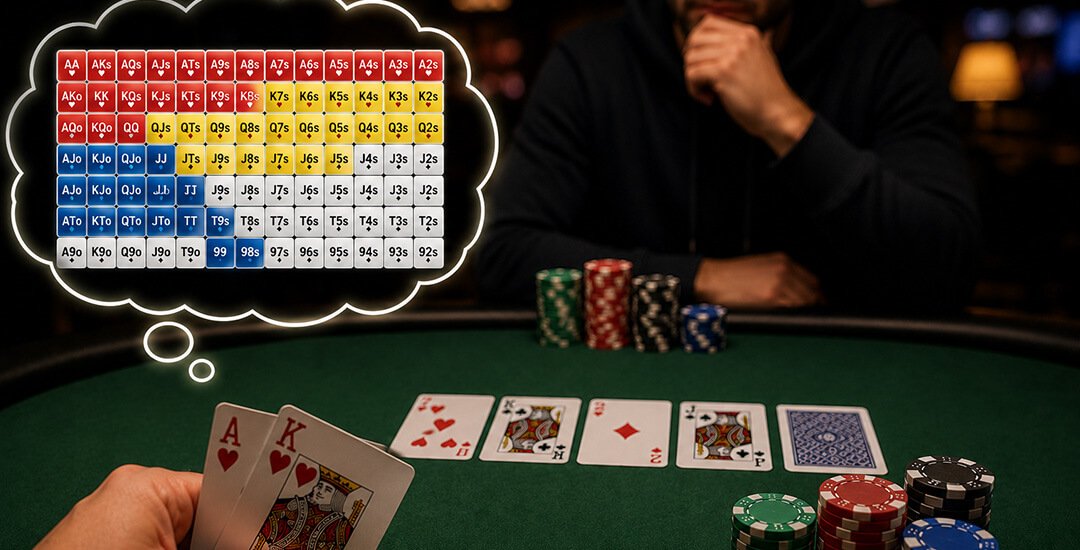
If you’re new to poker or looking to sharpen your skills, one of the most important concepts you’ll want to understand is the idea of a poker range. While it might sound technical or complicated at first, a poker range is simply a tool that helps you make better decisions at the table by thinking about all the possible hands your opponent could have. In this article, we’ll break down what a poker range is, why it matters, and how you can use it to improve your game.
What Exactly Is a Poker Range?
At its core, a poker range is a way to represent all the possible hands a player might have in a given situation. Instead of guessing one specific card combination your opponent holds, you consider a whole “range” of hands they could realistically have based on their actions.
For example, imagine your opponent just raised before the flop. You don’t know their exact hand, but their raise narrows down the list of possibilities. Their range might include strong hands like AA, KK, QQ, AK, AQ, and maybe some suited connectors like 98s or JTs. By thinking about this group of possible hands, you can plan your strategy accordingly.

Why Use Poker Ranges? The Basics
When you play poker, you’re constantly making decisions under uncertainty. You don’t have perfect information about your opponents’ cards, so you need a way to estimate what they might be holding. That’s where poker ranges come in. Here’s why they’re so useful:
- Avoid Guessing One Hand: It’s easy to get tunnel vision and assume your opponent holds a specific hand. Instead, ranges let you think about an entire set of plausible hands, which is more realistic.
- Better Decision Making: By considering a range, you can figure out whether your own hand performs well against it. This helps you decide whether to call, raise, or fold.
- Strategic Thinking: Using ranges allows you to plan your bluffs, value bets, and calls more effectively, because you understand what your opponent’s options might be.

How to Visualize and Read a Poker Range
Many players use charts or diagrams to represent poker ranges. One common tool is the poker hand grid, where every possible starting hand is shown in a matrix of 13 by 13 combinations. Here’s a quick rundown about this grid:
- Pairs: Hands like AA, 77, or 22 are shown along the diagonal since both cards are the same rank.
- Suited Hands: Hands like AK suited (AKs) are typically shown above the diagonal squares.
- Offsuit Hands: Hands like AKo (Ace-King offsuit) appear below the diagonal.
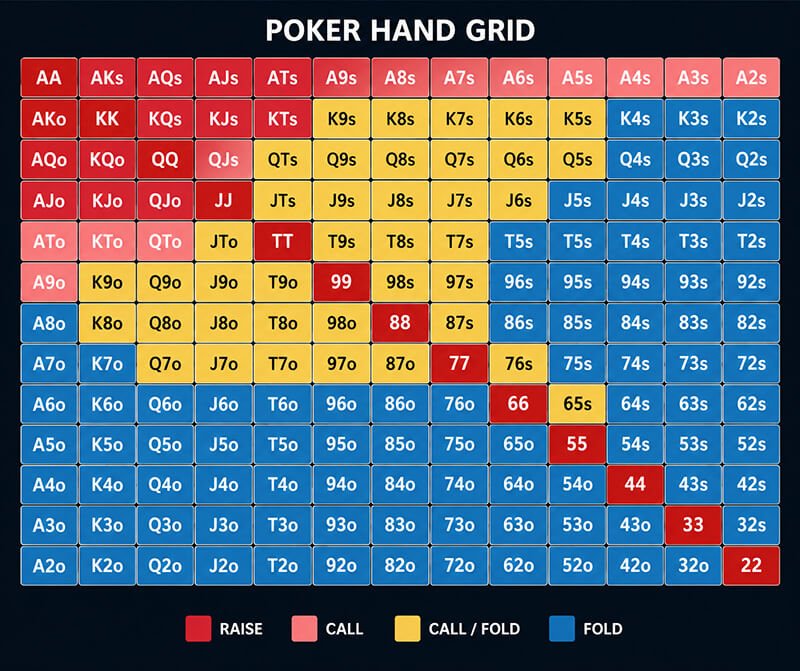
When you build a range, you mentally (or with a chart) highlight the combinations that make sense. For example, “my opponent’s opening range from early position might include all pocket pairs from 99 and higher, suited Aces, and some broadway offsuit hands.”
Putting Poker Range Into Practice: Examples
Let’s walk through a couple of practical examples to illustrate how poker ranges work in real play.
Example 1: Preflop Raise
You’re playing a cash game, and an opponent in middle position raises to 3x the big blind. What range of hands could they possibly have? Based on common poker strategy, their range might look like this:
- All pocket pairs 77 and above (77+)
- Suited broadway cards (like AKs, AQs, KQs)
- Strong offsuit broadway hands (AKo, AQo)
- Occasionally suited connectors (like 98s)
Knowing this, you can decide if your hand is strong enough to call or raise. For instance, if you hold pocket 9s (99), you’re just inside that range and might want to call or even 3-bet. But if you have something weaker like 72 offsuit, you should probably fold.
Example 2: Postflop Decision
Imagine you raised preflop with Ace-King suited and your opponent called. The flop comes Ks 7c 2d. Your opponent checks to you. What range might they have? Well, since they called a raise, their range includes:
- Strong top pairs (like KQ, KJ, or KT)
- Medium pocket pairs (77, 88, 99)
- Some draws like 98 suited or Queen-Jack suited
- Occasionally bluffs or weaker hands
By thinking about this range, you realize your Ace-King made top pair with strong kicker on the flop — a good spot to continue betting.
The Difference Between Range and Specific Hand
One key thing to remember: a specific hand is just one possible combination of two cards. For example, Ace of spades and King of hearts (A♠ K♥). But a poker range includes many possible hands grouped together. For instance, an opponent’s “opening range” might include 15-20% of all starting hands. That could be dozens of different combinations!
Thinking in terms of ranges keeps your play flexible. Instead of focusing on “my opponent has A♠ K♥ or they don’t,” you think, “My opponent likely has one of these 50 hands grouped in this range.” This approach allows you to develop more balanced strategies.
How would you describe your understanding of poker ranges?
How to Estimate Opponents’ Poker Ranges
Estimating an opponent’s range isn’t magic — it’s based on observation and understanding of poker strategy. Here are some tips:
- Position Matters: Players tend to play tighter (stronger hands) from early positions and looser from later positions.
- Betting Patterns: A raise or 3-bet typically signals strength; a limp (just calling) often shows weakness or speculative hands.
- Player Type: Tight players open fewer hands, so their ranges are smaller. Loose players play a wider variety of hands.
- Stack Sizes: Deep stacks encourage speculative hands; short stacks push you toward stronger ranges.
As you gain experience, you’ll intuitively assign likely ranges to different opponents in various situations.
Using Poker Ranges To Improve Your Play
Once you’re comfortable with the concept, poker ranges become a powerful tool to:
- Plan Bluffs: Identify the hands in your opponent’s range that you can force to fold by representing strong holdings yourself.
- Value Bet: Pick the right bet sizes to extract chips when you’re ahead of your opponent’s range.
- Defend Against Aggression: Know when to call or re-raise based on how your hand matches up against their range.
- Balance Your Play: Mix your betting and checking with a variety of hands so you don’t become predictable.
Common Mistakes to Avoid When Thinking About Ranges
New players often struggle with ranges in a few ways:
- Assuming a Single Hand: Avoid the trap of “my opponent must have this one hand.” Instead, always consider a range.
- Ignoring Position: Remember that opening ranges vary a lot depending on where a player sits.
- Not Updating Ranges: Adjust your assumptions based on how the action unfolds during the hand.
- Overcomplicating: Start simple with basic ranges and add complexity as you get comfortable.
Using Tools to Practice Ranges
Today, there are many free and paid tools available that help you learn and practice ranges, including range charts and poker solvers. These can show you which hands to play from different positions and how to adjust for various scenarios. Even simply studying starting hand charts is a great way to get a feel for common opening ranges.

Summary
Understanding what a poker range is and how to use it can transform your poker game. It takes you beyond guessing individual hands and helps you think about all the hands your opponent could have. This approach leads to smarter decisions, better reads, and more strategic play. Remember to start simple, observe how your opponents play, and gradually sharpen your skill at assigning and using poker ranges.
With practice, thinking in terms of ranges will become second nature, giving you a big edge at the poker table.
Editorial Note
Poker.kim uses artificial intelligence to assist with some content, including illustrations and draft text. Every article is reviewed, edited, and approved by our editorial team before publication.
If you spot an error or outdated information, we’d appreciate hearing from you so we can improve our content.