
Chinese Poker offers a refreshing twist on traditional poker games and is beloved for its straightforward rules and strategic depth. If you’ve ever been curious about how to play Chinese Poker or want to add a new game to your poker repertoire, understanding the Chinese poker rules is essential. This beginner-friendly guide will walk you through the basics, helping you get started with confidence.
What Is Chinese Poker?
Unlike more common poker variants such as Texas Hold’em or Omaha, Chinese Poker is played with each player receiving a fixed number of cards, which they then arrange into specific hands. It’s typically played by 2 to 4 players using a standard 52-card deck. The goal is to create three poker hands from your cards:
- One back hand (also called the bottom) – the strongest hand.
- One middle hand – a medium-strength hand.
- One front hand (also called the top) – the weakest hand, made with just 3 cards.
The uniqueness lies in how you set these hands and how they compare to other players’ hands. Because each player makes multiple hands, the game involves interesting strategic decisions different from traditional poker setups.

Basic Setup and Card Distribution
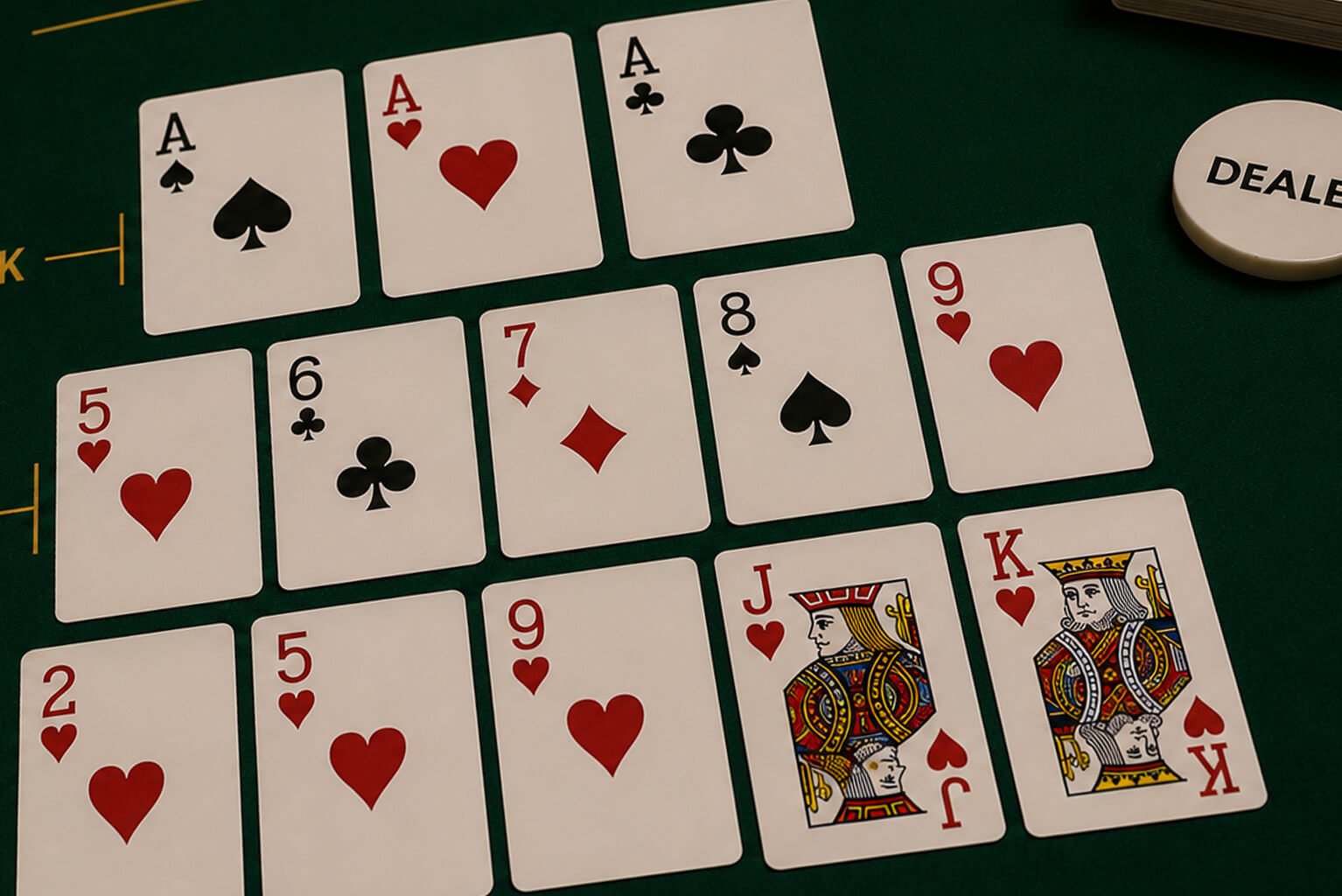
The game uses a regular 52-card deck with no jokers. Each player is dealt 13 cards face down. All the 13 cards must be arranged into three hands:
- Back (bottom) hand: 5 cards (this should be your strongest 5-card poker hand)
- Middle hand: 5 cards (this hand should be weaker than your back hand but stronger than your front hand)
- Front (top) hand: 3 cards (this is your weakest poker hand)
Players carefully arrange the cards once all have been dealt. Then hands are revealed and compared between players.
How to Arrange Your Hands
Here’s the critical rule in Chinese Poker setup: your back hand must be stronger than your middle hand, and your middle hand must be stronger than your front hand. If you don’t follow this, you automatically “foul” and lose the round.
Since the front hand has only 3 cards, its highest possible hand is three of a kind, as straights and flushes don’t count in the three-card hand.

Ranking Poker Hands for Chinese Poker
Understanding how to rank poker hands is critical here. The hand rankings from highest to lowest are:
- Royal Flush
- Straight Flush
- Four of a Kind
- Full House
- Flush
- Straight
- Three of a Kind
- Two Pair
- One Pair
- High Card
For the 3-card front hand, only three of a kind, one pair, and high card apply. Straights and flushes don’t count in the front hand.
Gameplay Example
Imagine you receive the following 13 cards:
A♠, A♦, K♠, Q♠, J♠, 10♠, 9♠, 9♦, 8♥, 7♥, 4♣, 2♠, 2♦
You might arrange your hands like this:
- Back hand (5 cards): A♠, K♠, Q♠, J♠, 10♠ (Royal Flush – very strong)
- Middle hand (5 cards): A♦, 9♠, 9♦, 8♥, 7♥ (a pair of Nines)
- Front hand (3 cards): 4♣, 2♠, 2♦ (a pair of Twos)
Notice how the back hand is the strongest, followed by the middle, and finally the front, which is the weakest with only a pair. This setup follows the Chinese poker rules perfectly.
Comparing Hands and Scoring
Once all players reveal their hands, you compare your three hands against each opposing player’s corresponding hands. Each of your hands – front, middle, and back – competes separately against the same category from your opponent.
For example, your back hand against your opponent’s back hand, and so on. The player who wins at least two out of three hands wins the overall round.
Scoring methods can vary by house rules, but the most common system is:
- 1 point for each hand won.
- 1 bonus point if you win all three hands (called a “scoop”).
If a player fouls (arranges their hands incorrectly), they typically lose all points to every opponent.

Important Strategies for Beginners
Because it’s a game of positioning rather than betting rounds, your key decisions lie in correctly ranking and distributing your cards. Here are some tips:
- Focus on a strong back hand: Since this is the strongest and usually highest-scoring hand, start here and build outwards.
- Balance your middle and front hands carefully: Don’t weaken your middle hand too much, or it may lose badly. The front hand should be the weakest but aim for at least a pair to win some points.
- Keep an eye on fouling: Misordering your hands results in an automatic loss, so double-check your setup.
- Practice arranging different hands: The more familiar you are with the hand rankings and combinations, the easier it will be to make quick decisions.
Variations of Chinese Poker
Once you get comfortable with basic Chinese Poker rules, you might encounter or want to try some popular variations:
- Pineapple Open-Face Chinese Poker: Players receive cards gradually and place them face up, resulting in more strategy and skillful hand arrangement.
- OFC with Royalties: Additional bonus points for rare high-value hands like quads, straight flushes, and royals.
- 3-4 Player Games: While typically played with 4 players, some variations support 2 or 3 players with adjusted scoring.
Final Thoughts
Chinese Poker is a fantastic way to enjoy poker in a new style that emphasizes hand arrangement and comparative competition rather than betting rounds. By understanding the core Chinese poker rules and practicing how to build strong, balanced hands, you’ll find this game both fun and challenging.
Give it a try with friends or online, and you’ll quickly see why it has become a favorite for casual and serious poker players alike. Remember, the key is to keep your back hand strongest, your middle hand solid, and your front hand weakest without fouling. Happy arranging, and good luck at the tables!