
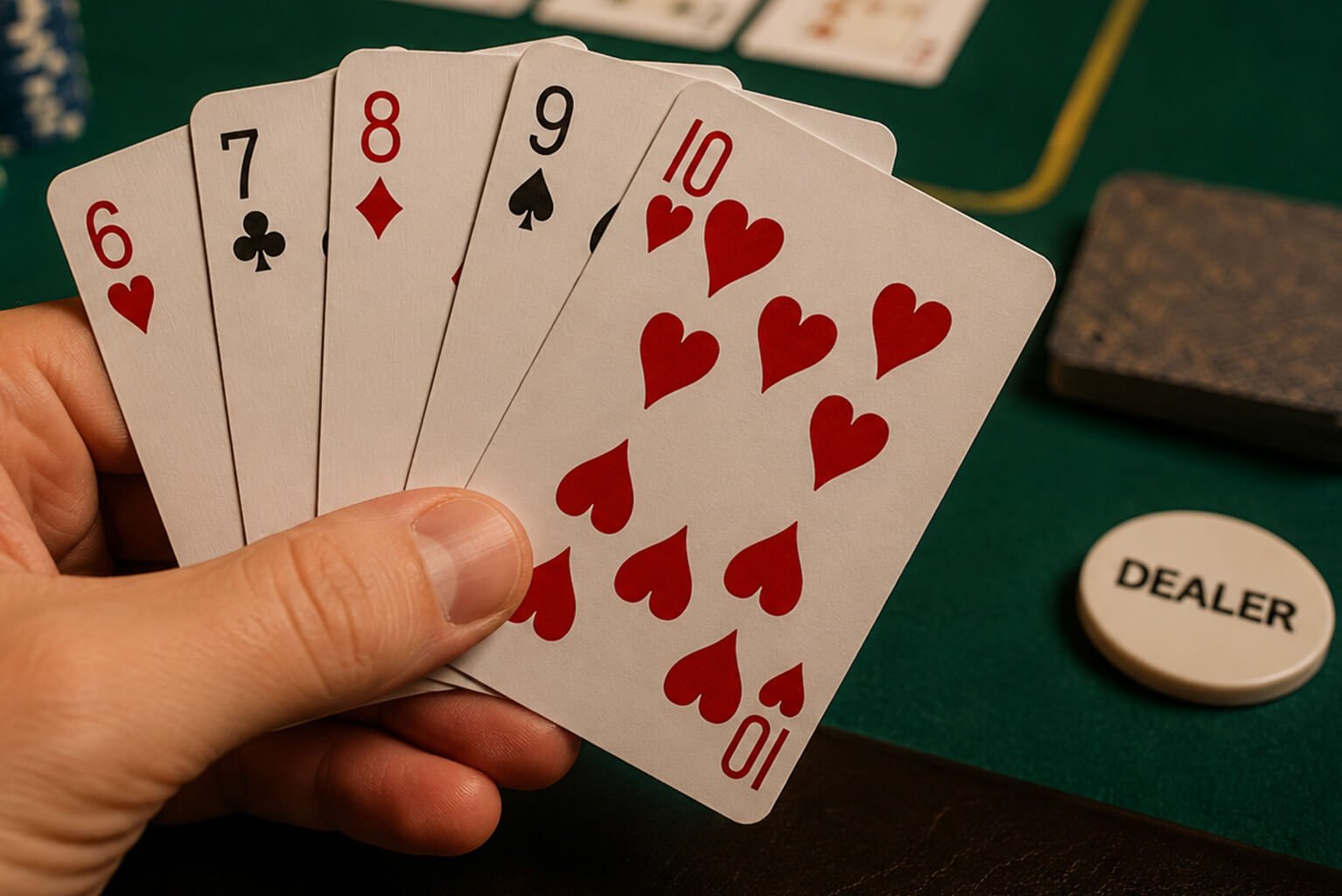
When you’re just starting out in poker, you’ll often hear players talk about different hands and their ranks. One of the most common hands you’ll come across is a “straight.” Understanding what a straight is in poker is essential because it’s a fundamental part of the game and can often be a winning hand. In this article, we’ll break down what a straight poker hand is, how it works, and give you some practical examples to help you spot it in real games.
What Is a Straight in Poker?
A straight in poker is a hand where you have five cards in sequential order, but they don’t have to be the same suit. For example, having 4♦ 5♠ 6♣ 7♥ 8♣ forms a straight because all five cards are consecutive numbers, regardless of their suits.
It’s important to note that the cards must be consecutive in rank to qualify as a straight:
- The cards run in a sequence, like 3, 4, 5, 6, 7.
- Suits can be mixed, so the cards don’t have to be all hearts, spades, etc.
- Aces can be high or low, but only in specific ways.

The Ace’s Role in a Straight
Ace is a special card that can act as the lowest or the highest card in a straight:
- Low Ace Straight: A-2-3-4-5 is called the “wheel.” Here, Ace counts as 1.
- High Ace Straight: 10-J-Q-K-A is the highest possible straight, often called “Broadway.”
However, the Ace cannot wrap around in the middle of the sequence, so Q-K-A-2-3 is not a straight.
Why Is the Straight Important in Poker?
The straight is a relatively strong hand in poker, ranking above three of a kind and below a flush. To understand its strength, you should be aware of the poker hand ranking hierarchy:
- High Card
- One Pair
- Two Pair
- Three of a Kind
- Straight
- Flush
- Full House
- Four of a Kind
- Straight Flush
- Royal Flush
Knowing where the straight fits in helps you make better decisions about betting, folding, or calling.
How to Identify a Straight with Real-Life Examples
Let’s dive into some practical examples to make the concept clearer.
Example 1: Simple Straight
Imagine you have the cards 7♣ and 8♦ in your hand. The community cards on the table are 5♥, 6♠, 9♦, K♣, and 2♠.
Looking at all seven cards, the best five-card combination you can make includes 5♥, 6♠, 7♣, 8♦, and 9♦, which is a straight from 5 to 9. Even though you have a 2 and a King, they aren’t part of your best hand here.
Example 2: Low Ace Straight
Suppose you have A♠ and 3♦ in your hand, and the community cards are 2♣, 4♠, 5♥, J♦, and 9♣.
Here, your best hand is A♠, 2♣, 3♦, 4♠, and 5♥, which forms a straight going from Ace (low) to 5. This hand is colloquially called the “wheel.”
Example 3: High Ace Straight
You’re holding 10♠ and J♣, and the board shows Q♦, K♠, 3♥, 7♣, and 2♦.
The five-card straight is 10♠, J♣, Q♦, K♠, A. Wait — where’s the Ace? Good catch! Even if you don’t have an Ace in your hand, if the community cards contain an Ace, you can create the high straight.
If the community cards had an Ace♣ instead of the 2♦, your best straight would be 10-J-Q-K-A, which is the highest straight possible.
Tips for Playing Straight Poker
Here are some beginner-friendly tips to improve your play when you think you’re drawing or holding a straight:
- Watch the Board: Always pay attention to community cards. If you see four cards in a sequence, it’s a sign that someone may be completing a straight.
- Read Your Opponents: If the betting suddenly gets aggressive and the board is showing potential straights, be cautious — multiple players may have strong hands.
- Don’t Overestimate: Sometimes a potential straight on the board can be beaten by a flush or a full house. Always consider the possibility of stronger hands.
- Use Position: Being last to act gives you crucial information about other players’ actions and can help you decide when to bet or fold with a straight.
Common Misconceptions About Straights
Let’s clear up a few areas where beginners often get confused.
Suits Don’t Matter in a Straight
Many new players think that all five cards must be of the same suit to make a straight. That’s not true; suits are irrelevant for straights. As long as the ranks are consecutive, it’s a straight. If suits are all the same, then the hand is a straight flush, which is even stronger.
Ace Can Only Be High or Low, Not Both
The Ace can’t be in the middle of a straight. So hands like K-A-2-3-4 are not valid straights, even though the ranks might look sequential.

You Can Use Any Card Combination
In games like Texas Hold’em, where you have two hole cards and five community cards, your five-card hand can be made up from any combination of those seven cards. This flexibility means you can sometimes use one card from your hand and four from the board or two and three, depending on where your best straight lies.
Straight Poker Variations
Straight poker applies to many poker variants, but some games emphasize straights more than others:
- Texas Hold’em: The most popular poker variant, where straights are common and important.
- Omaha: Similar to Texas Hold’em but with four hole cards, making straights more frequent and often trickier to spot.
- Seven Card Stud: Straights can form using any of the seven cards dealt to each player.
Regardless of the game, learning to identify straights and understand their strength is a foundational skill.

Summary
A straight in poker is a hand made up of five cards in numerical order, no matter the suit. It ranks above three of a kind but below a flush, making it a strong and valuable hand to know. The Ace can be used as either the lowest or highest card, but never in the middle of the sequence. Recognizing straights quickly and understanding their role in the game will give you an edge at the table.
Next time you play, pay attention to the board and your cards to see if you can build a straight — it might just be the winning hand you need.